In short
How to Build a SaaS MVP
A SaaS MVP needs five things: authentication with tenant separation, the single workflow that delivers the core value, subscription and payment handling, an admin console for support, and basic analytics. Everything else — integrations, roles, mobile apps, reporting suites — waits until real users have proved the core workflow is worth paying for.
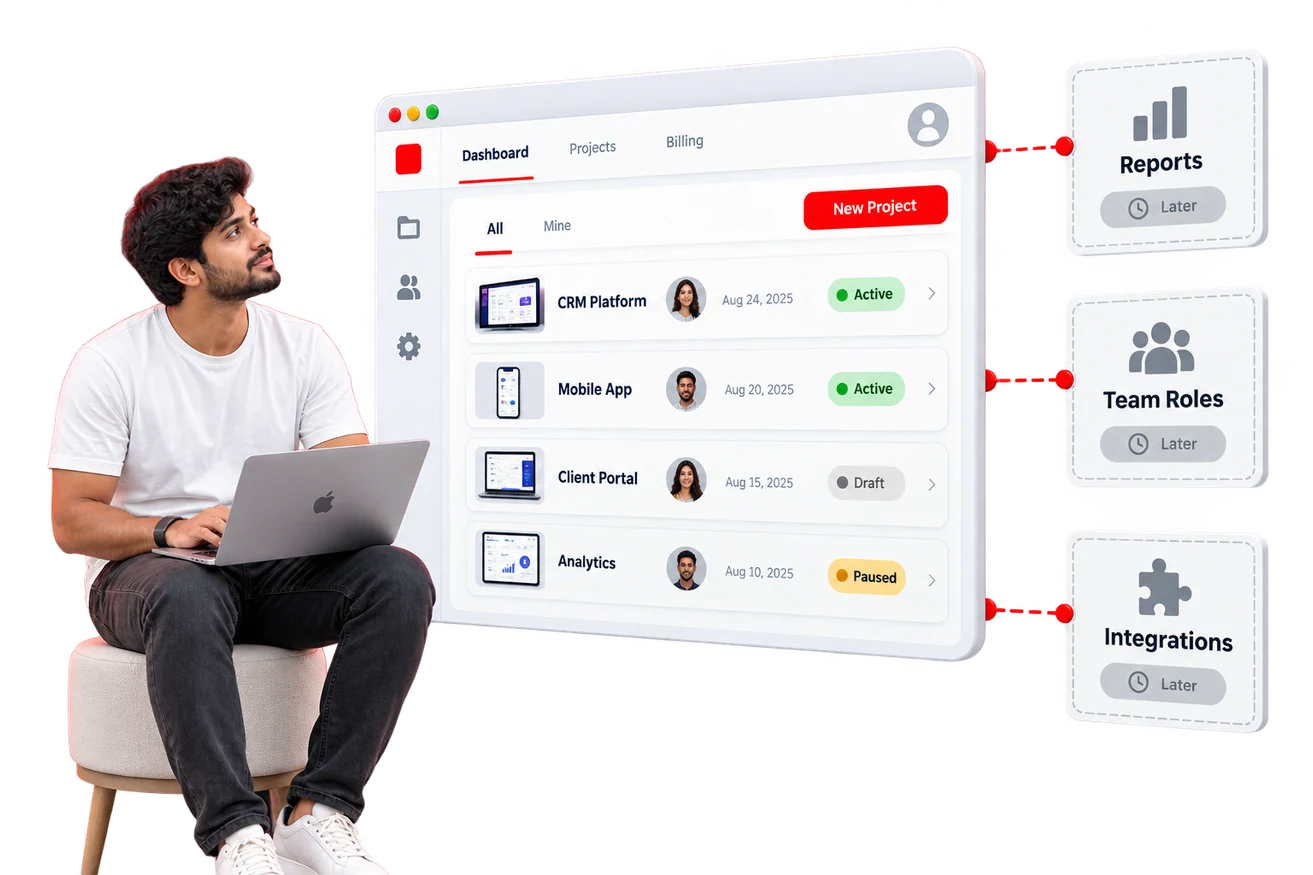
The word minimum causes most of the damage. Teams read it as 'a rough version of everything' and build twelve half-finished features. The useful reading is 'the smallest complete thing that tests whether people will pay' — which means one workflow built properly, surrounded by the plumbing a real customer requires.
The five things an MVP genuinely needs
1. Authentication with tenant separation
Sign-up, sign-in, password reset, invitations, and — critically — data isolation between customer accounts. Enforce isolation in the database with row-level security or an equivalent server-side mechanism, not only in application code. A leak between tenants is the one bug a B2B SaaS product rarely recovers from.
2. The core workflow, built well
Identify the single sequence of actions that delivers the value your product promises. Build that end to end, polished, fast, and handling its own error cases. Users forgive missing features. They do not forgive the main thing being unreliable.
3. Subscription and payment
Plans, checkout, recurring billing, failed-payment handling, upgrades, downgrades, cancellation and invoices. This is more work than teams expect, which is why it gets deferred — and deferring it means you never learn whether anyone will actually pay.
4. An admin console
Your own team needs to look up an account, see its plan and usage, extend a trial, reset access and diagnose a complaint without opening a database client. Skip this and your engineers become the support desk.
5. Basic analytics
Sign-ups, activation, the core action completed, retention by cohort and churn. Five numbers, instrumented from day one. Adding analytics later loses the only period of data you cannot recreate.
What to leave out — deliberately
- Granular role and permission hierarchies — start with admin and member
- Third-party integrations, until customers name a specific one as a blocker
- White-labelling and custom domains
- A mobile application, if the web app is responsive
- A reporting suite — one dashboard with five numbers is enough
- An internal design system, before there are enough screens to justify it
- Micro-services — a well-structured single application is faster to change
Architectural decisions worth making early
A few choices are cheap now and expensive later:
- Tenant isolation enforced at the database layer from the first migration
- An audit log on every write — you will need it for support and compliance
- Feature flags tied to plans, so pricing tiers do not require code changes
- Background job processing, so slow work never blocks a request
- An API from the start, even if only your own frontend calls it
- Environment separation with secrets in a secret manager, not in the repository
A sequence that reaches paying users
- 01Weeks 1–2: define the core workflow, the data model and the pricing hypothesis.
- 02Weeks 3–4: authentication, tenancy and the application shell.
- 03Weeks 5–10: the core workflow, built properly, reviewed weekly.
- 04Weeks 11–13: billing, plans, invoices and the admin console.
- 05Weeks 14–15: analytics, onboarding and the empty-state experience.
- 06Weeks 16+: closed pilot with paying users, then iterate on what they actually struggle with.
The mistake that wastes the most money
Building for the enterprise customer you hope to win in year three. Single sign-on, audit exports, custom contracts and a permissions matrix are real requirements — for a company with enterprise customers. Building them before you have any customer at all consumes the runway you needed to find one.
Frequently asked questions
How long should a SaaS MVP take?
Twelve to twenty weeks for most B2B products with a single core workflow, billing and an admin console. Longer than that usually means the scope is a full product, not an MVP.
Should an MVP be multi-tenant from day one?
Yes. Retrofitting tenant isolation onto a single-tenant application is one of the most expensive rewrites in software. Enforce it at the database level from the first migration.
Should the MVP include billing?
If you intend to charge, yes. Willingness to pay is the hypothesis you are testing, and a free pilot with a promise to charge later does not test it.
WRITTEN BY THE REDLITMUS TEAM · SAAS · LAST UPDATED 30 JUNE 2026