
In short
How API Integration Connects Business Systems
API integration connects business systems by having one system call another's documented interface, or by publishing events through webhooks. A reliable integration defines a source of truth for each field, chooses real-time or scheduled sync per data flow, and implements authentication, idempotency, retries with backoff, conflict rules and monitoring so failures are visible immediately.
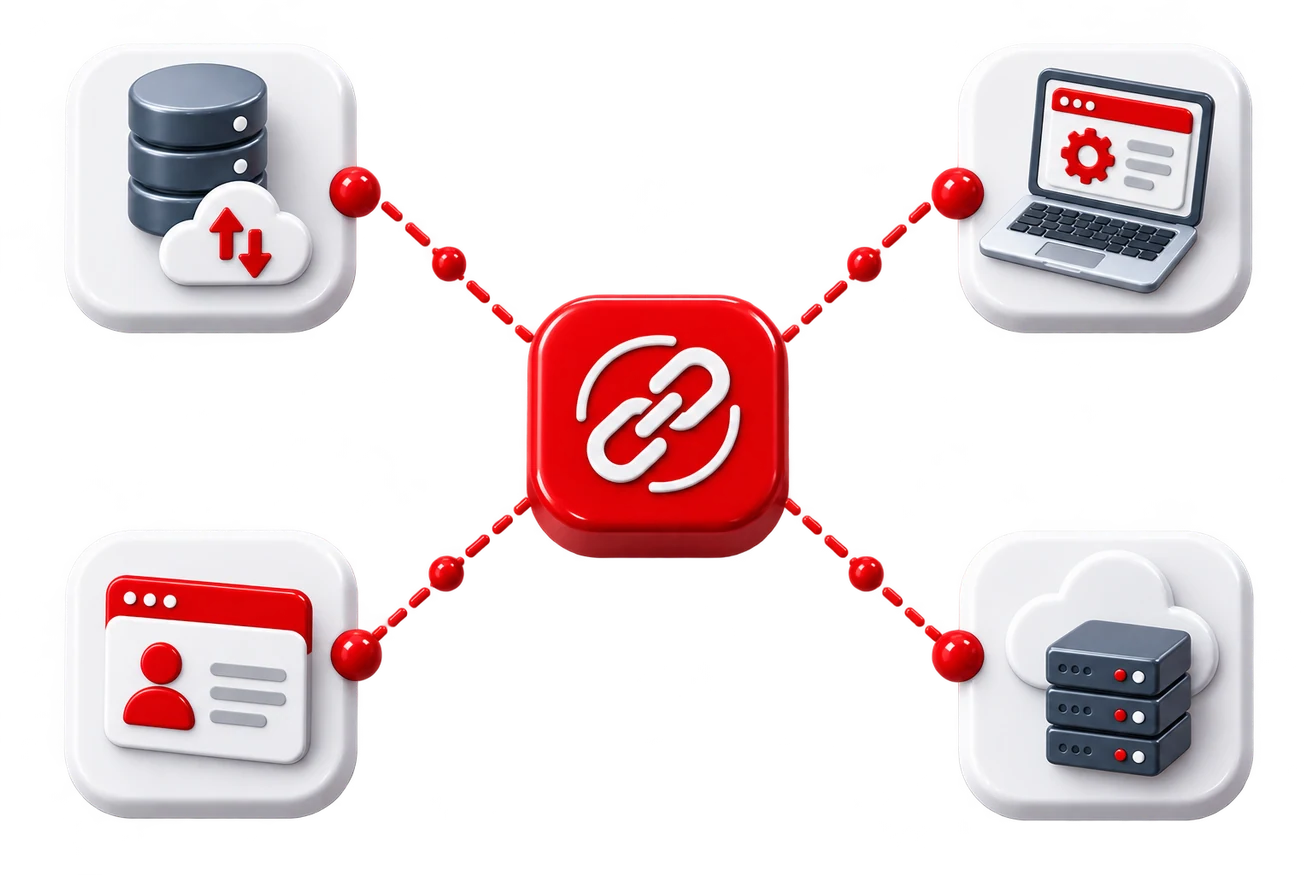
Every growing business ends up with the same problem: six systems that each hold part of the truth, and people acting as the transport layer between them. Integration replaces those people with interfaces — but only if it is built to survive the conditions of production, which are messier than the API documentation suggests.
The three ways systems connect
Request–response APIs
One system asks another for data or tells it to do something, and waits for a reply. Simple, predictable, and the right choice when you need an answer immediately — checking stock at checkout, validating a customer, fetching an order status.
Webhooks and events
A system notifies yours when something happens, so you do not have to poll. More efficient and far more timely — but you must accept that delivery is best-effort. Verify signatures, respond quickly and process asynchronously, and expect the occasional duplicate or missed event.
Scheduled batch
Files or bulk API pulls on a schedule. Unfashionable and often correct: it is simple to reason about, easy to re-run, and perfectly adequate for master data, reconciliation and reporting.
Decide the source of truth before writing code
This is the decision that determines whether an integration is stable. For every field that exists in more than one system, write down which system owns it, which direction it flows, and what happens when both change between syncs.
| Data | Source of truth | Direction | Frequency |
|---|---|---|---|
| Customer contact details | CRM | CRM → store, support | On change |
| Product price | ERP | ERP → store | Near real-time |
| Stock level | Warehouse system | Warehouse → store | Real-time at checkout |
| Order | Store | Store → ERP, logistics | On creation |
| Invoice | Accounting | Accounting → CRM | Nightly |
A table like this, agreed before development, prevents the most common integration failure: two systems overwriting each other in a loop because both believed they owned the same field.
What separates a demo from production
- Authentication handled properly — credentials in a secret manager, tokens refreshed automatically, least-privilege scopes
- Idempotency — the same event delivered twice produces one record, using a stable external key
- Retries with exponential backoff for transient failures, and a dead-letter queue for permanent ones
- Rate-limit awareness — respect the limit and queue rather than hammering and being blocked
- Partial-failure handling — a batch of 500 where 3 fail must not silently discard the 3
- Schema tolerance — an unexpected new field should not crash the consumer
- An exception queue a human can review, with enough context to fix and replay
Monitoring you should insist on
- A log of every exchange with timestamp, payload reference and outcome
- Alerting on error-rate thresholds and on unexpected silence
- A dashboard showing last successful run per integration
- Reconciliation counts — records in system A versus system B, compared daily
- A runbook naming who is alerted and what they should do
Sequencing an integration project
- 01Inventory the systems and what each can actually expose.
- 02Write the data contract: ownership, direction, frequency, conflict rules.
- 03Build the highest-value flow first, in one direction only.
- 04Test failure explicitly — timeouts, malformed payloads, duplicates, rate limits.
- 05Run in parallel with the manual process and reconcile the outputs.
- 06Add monitoring and alerting before switching off the manual process.
- 07Only then add the second direction or the next flow.
Teams that do this in the reverse order — building every flow at once and adding monitoring last — spend the following year debugging data quality issues whose origin nobody can trace.
Frequently asked questions
What if a system has no API?
Look for a scheduled export, a reporting database, or a file drop over SFTP. If none exists, the honest options are to keep that step manual with a defined checkpoint, or to replace the system. A scraped interface is not an integration — it breaks on the vendor's next release.
Should integrations be real-time or scheduled?
Per flow, not per project. Payments and stock usually need real-time or near real-time; master data and reporting are often fine on a nightly schedule, which is simpler and cheaper to operate.
How do you stop duplicate records?
Define a matching key, make write operations idempotent using a stable external identifier, and store the mapping between systems so a retried delivery updates the existing record instead of creating a second one.
WRITTEN BY THE REDLITMUS TEAM · SYSTEM INTEGRATION · LAST UPDATED 22 JUNE 2026