In short
Custom Software vs Off-the-Shelf Software
Choose off-the-shelf software when your process is standard, the product covers it, and per-seat cost stays reasonable at your headcount. Choose custom development when the process is a competitive advantage, when licence costs scale badly, when critical gaps cannot be configured away, or when deep integration with your own systems is required.

The honest default is to buy. A packaged product has been debugged by thousands of customers, it is available today, and someone else maintains it. Any competent development partner should tell you this before quoting for a build. The interesting question is not which is better in general — it is which specific conditions flip the answer.
Four conditions that justify building
1. The process is a competitive advantage
If the way you quote, schedule, allocate or price is genuinely different from your competitors and it is why customers choose you, forcing it into a product designed for the average case erodes the advantage. Standard processes — payroll, accounting, email — should always be bought.
2. Licence cost scales badly against your headcount
Per-seat pricing is fine at fifteen users and painful at two hundred. Model the five-year cost at your projected headcount, including the modules you will be forced to upgrade into. For operations teams where every field employee needs access, this alone often decides it.
3. The gaps are in the part that matters most
Every product has gaps. The question is where they fall. A CRM that cannot express your approval chain is an inconvenience; a CRM that cannot express your pricing model is a blocker. Watch for the tell-tale sign: a team that maintains a private spreadsheet alongside the official system. That spreadsheet is the requirement the product failed to meet.
4. You need deep integration with systems you own
Packaged products integrate on their terms, through the fields and events their API exposes. When your workflow requires a system to react to your internal events in your own sequence, a build gives you control that configuration cannot.
Cost, compared properly
| Factor | Off-the-shelf | Custom build |
|---|---|---|
| Upfront cost | Low — subscription starts immediately | Higher — the build is paid before value |
| Cost over 5 years | Grows with headcount and tier upgrades | Largely fixed after build, plus support |
| Time to value | Days to weeks | Weeks to months |
| Process fit | You adapt to the product | The product models your process |
| Ownership | Vendor owns the platform and roadmap | You own code, data and deployment |
| Maintenance | Included in subscription | Your responsibility, or a support arrangement |
| Risk | Vendor pricing changes, feature removal, shutdown | Delivery risk, and dependence on maintainable code |
The risks of building, stated plainly
- Scope drift — requirements grow during the build unless they are fixed in writing
- Key-person dependency — code that only one developer understands
- Under-specified exceptions — the edge cases nobody mentioned until launch week
- Neglected maintenance — no budget allocated after go-live
All four are manageable, and all four are avoidable with the same discipline: written scope, standard technology, documentation as a deliverable, and an agreed support arrangement before launch rather than after.
The third option most people miss
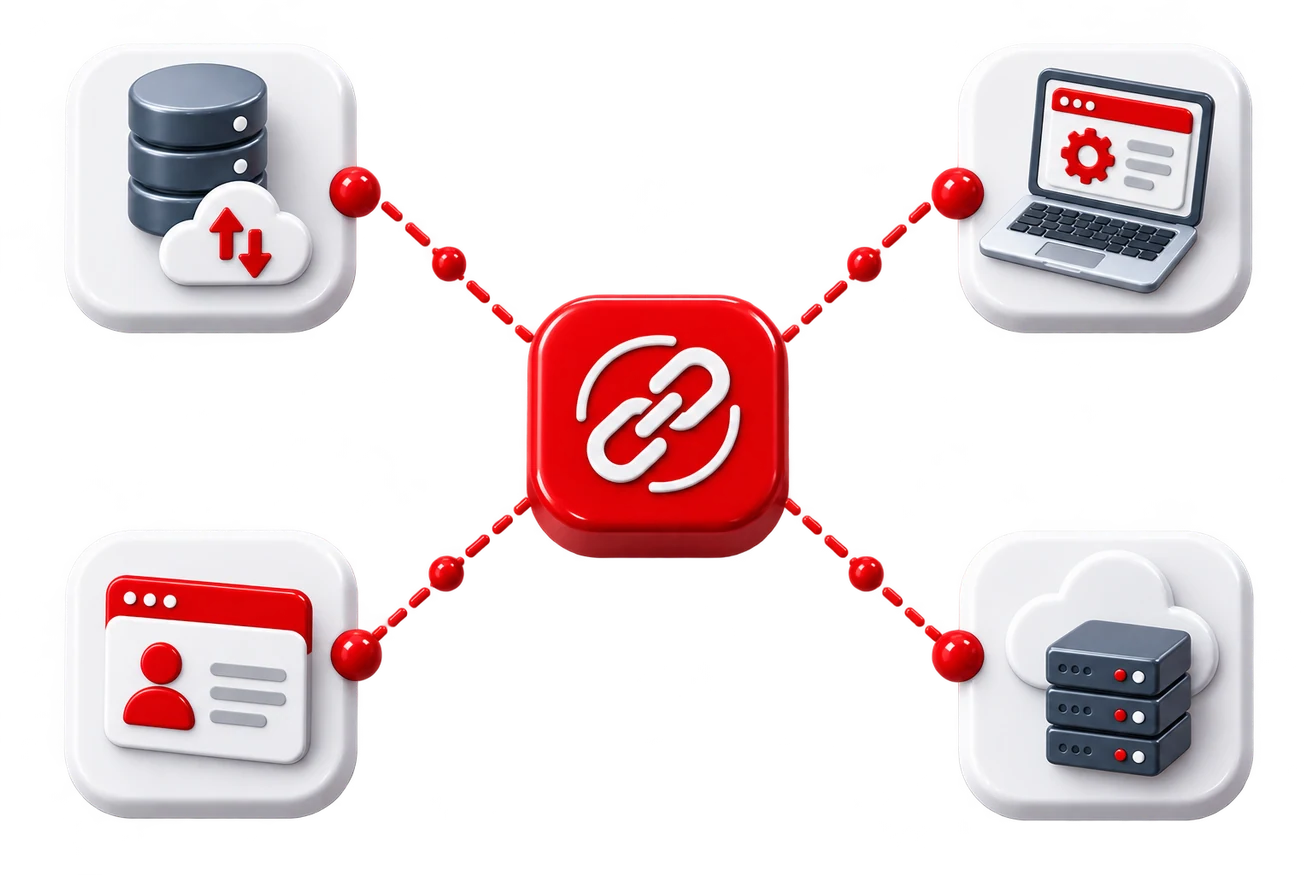
You do not have to choose one for the whole business. The common pattern that works well is buying commodity systems — accounting, payroll, email, storage — and building only the operational core that is specific to you, then integrating the two. This keeps the build small, keeps the commodity software cheap, and puts the engineering effort where it produces advantage.
That approach depends entirely on integration quality. If the custom core cannot exchange data reliably with the packaged systems around it, you end up with the costs of both approaches and the benefits of neither.
Frequently asked questions
Is custom software always more expensive?
Higher upfront, often lower over five years. The comparison people miss is per-seat licensing multiplied by headcount growth, plus the cost of the workarounds a poor fit forces on staff every day.
Can we start with a packaged product and move to custom later?
Yes, and it is often the right sequence. Use the packaged product to learn what your process really needs, keep your data exportable, and build custom once the requirements are proven rather than guessed.
How long does custom software take to build?
A focused first version of a business application typically takes eight to sixteen weeks depending on scope and integrations. Anything quoted as two weeks is either very small or under-scoped.
WRITTEN BY THE REDLITMUS TEAM · SOFTWARE DEVELOPMENT · LAST UPDATED 11 AUGUST 2026